
How to build a lead generation funnel on Facebook
Meta Ads Playbook
Sound Familiar?
A lead generation funnel is what turns a stranger scrolling their feed into someone who books a call, requests a quote, or buys — and building one properly on Facebook in 2026 looks different than it did even two years ago.
Why Your Facebook Leads Aren't Turning Into Sales
Meta has pushed hard toward automation — Advantage+ campaigns now handle audience selection and budget allocation that used to be manual — while at the same time tightening what data actually reaches the algorithm. Privacy changes forced a shift to server-side tracking, and by 2026 Meta’s Conversions API is a one-click, Meta-hosted setup rather than a developer project, with direct CRM integrations for platforms like Salesforce and HubSpot.
Lead quality has also become the industry’s biggest headache: many advertisers have seen cost-per-lead spike over 20% as instant forms fill up with low-intent submissions. Whether you run a local service business or a B2B pipeline, the businesses solving this are the ones building a real funnel — not just running an ad.
Who This Funnel Is Built For
The Cost of Skipping a Real Funnel
Many businesses assume a “lead generation” ad objective does all the work by itself — launch it, collect form fills, done. The reality is closer to the opposite: without a structured funnel behind it, Facebook happily keeps filling your inbox with cheap, low-intent leads that never convert. Skip this and you’ll keep paying for volume while your actual sales stay flat, your team wastes hours chasing dead leads, and the algorithm never gets the quality signal it needs to find you better prospects.
Inside the Funnel: How Each Stage Works
A section-by-section breakdown of how each stage of the funnel actually works.
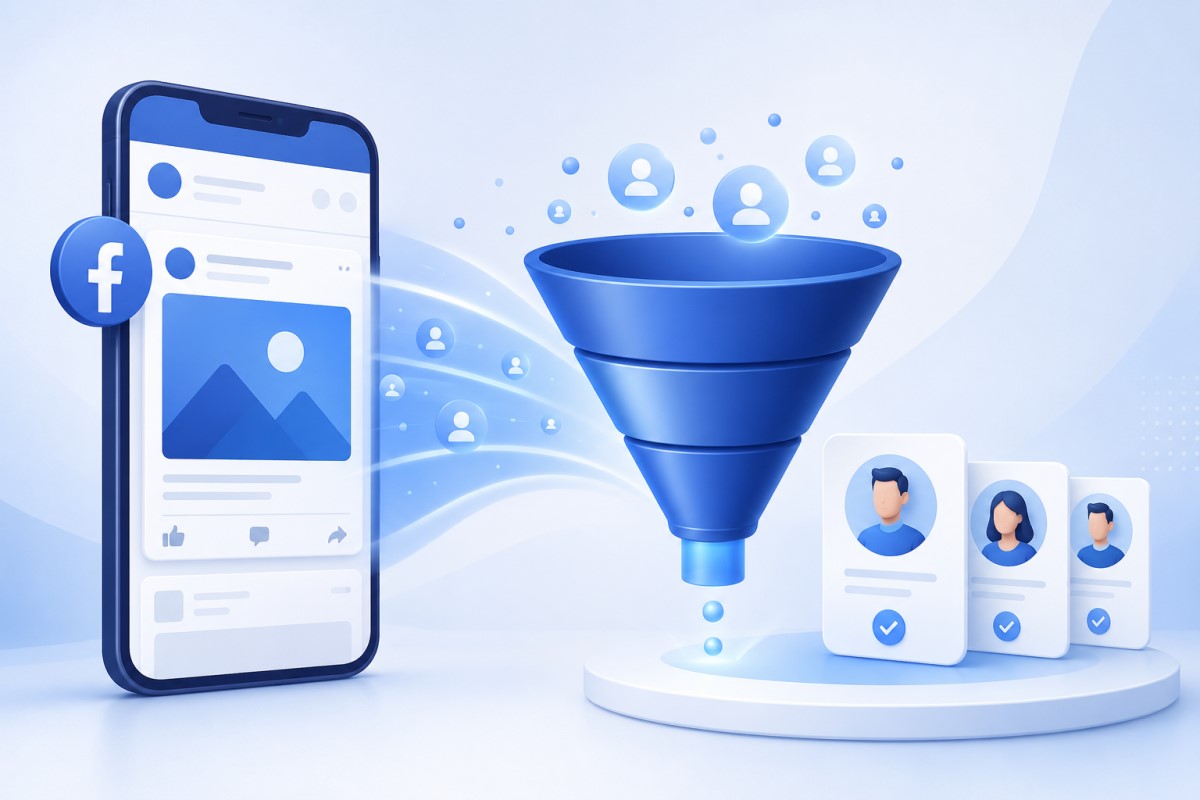
A structured path that takes someone from first seeing your ad to becoming a customer, built around three stages: awareness (a cold audience discovers you), capture (they hand over contact details in exchange for an offer), and conversion (your follow-up turns them into a paying customer). Without all three stages working together, ad spend just generates noise.
Broad, engaging content — video, testimonials, before/after results — introduces your brand to a cold audience. In 2026 this stage is best run through Advantage+ audience targeting, which Meta’s own data shows can lower cost per lead by around 8% compared to manually built audiences, especially when paired with instant forms.
- Instant Forms (native Facebook forms) reduce friction and load instantly
- Website or landing page forms let you pre-qualify and pass richer data back to Meta
- Running both together outperforms either alone — advertisers combining the two have seen roughly 60% lower cost per lead and 125% more lead volume than website forms by themselves
- A clear, specific lead magnet (checklist, quote, consultation) outperforms a generic “contact us” offer
This is where most funnels quietly fail. Leads need a fast, structured follow-up — automated email or SMS sequences, a retargeting audience built from people who opened the form but didn’t finish, and a CRM that logs who actually became a customer. That last part matters more than it sounds: the businesses converting best in 2026 are feeding real outcomes back into Meta, not just counting form fills.
Meta’s Conversions API now has a one-click, Meta-hosted setup, and direct integrations with CRMs like Salesforce and HubSpot let you send real lead and sale outcomes straight back to the ad platform. Advertisers using this managed CAPI setup instead of pixel-only tracking have reported around 17.8% lower cost per result — because the algorithm is finally optimizing toward leads that actually turn into revenue, not just form submissions.
Is Your Business Ready?
You’re Ready If…
- You have a CRM (or at minimum a spreadsheet) to log and follow up on every lead
- You can commit at least $1,000–1,500 per month for the algorithm to gather data
- You have a clear, specific offer or lead magnet — not just “contact us”
- You’re willing to set up Conversions API for accurate tracking
- Someone on your team can respond to new leads within minutes, not days
Not Yet, If…
- You have no follow-up process and leads currently sit untouched
- Your budget is under roughly $30–50 per day per campaign
- Your offer is vague or identical to every competitor’s
- You haven’t set up Conversions API or a pixel at all
- You expect results within days rather than a few weeks of testing
What Works
- Run Instant Forms and a website landing page in parallel, not one or the other
- Set up Conversions API (Meta’s managed one-click option) from day one
- Sync your CRM so Meta learns from real sales, not just form fills
- Segment retargeting by funnel stage (viewed, started form, submitted, purchased)
- Test Advantage+ against a manual campaign over a 4-week window before committing
What to Avoid
- Launching lead ads with no follow-up sequence waiting on the other end
- Optimizing purely for lead volume instead of lead quality
- Skipping Conversions API and relying on pixel-only tracking
- Cutting budget so low the algorithm never leaves the learning phase
Turning Clicks Into Customers
The businesses winning with Facebook lead generation in 2026 are rarely the ones who just boost a post — they’re the ones who build the full funnel: a clear offer, a fast follow-up, clean tracking, and enough budget for the algorithm to learn. Get the funnel right, and the ad spend finally turns into real customers.